The GROklahoma Podcast Show
Our podcast takes you on a journey to explore the different resources and support available for clinical and translational research in Oklahoma. We’ll speak with experts in the field, as well as researchers who have benefited from these resources. Join us as we discuss funding opportunities, collaboration tools, regulatory support, and more. Whether you’re just starting out in the field or are a seasoned researcher, our podcast is here to help you discover the resources available to support your work. From access to state-of-the-art equipment to networking opportunities with other researchers and clinicians, mentoring tips, our podcast covers a wide range of topics related to clinical and translational research resources in Oklahoma.
Listen on:








Episodes

Tuesday Dec 23, 2025
Tuesday Dec 23, 2025
In this year-end episode, we sit down with Dr. Deirdra "Dee" Terrell, a Professor of Epidemiology at the Hudson College of Public Health at the University of Oklahoma Health Sciences Center, for a thoughtful conversation about what it really takes to do research that stays connected to people.
Dr. Terrell reflects on her journey from growing up in a small rural town in Oklahoma to becoming a clinical epidemiologist whose work focuses on platelet disorders such as immune thrombocytopenia and thrombotic thrombocytopenic purpura. She shares how family, early experiences with illness, and life outside the lab have shaped her approach to science and leadership. We talk about why listening to patients matters, what qualitative and mixed-methods research can reveal that clinical measures alone often miss, and how research decisions affect people’s daily lives in ways that are not always visible on paper.
The conversation also explores mentoring, networking, and community building as relational work. Dr. Terrell shares how meaningful connections, thoughtful sponsorship, and everyday kindness have influenced her path and her approach to guiding students and colleagues. As we close out the year, we reflect on sustainability, rest, and staying grounded while carrying responsibility. This episode is an invitation to pause, take stock, and think about what kind of work, relationships, and values we want to carry into the year ahead.
We’ll see you in the new year, ready to keep the conversation going.
The GROklahoma Podcast is an initiative of the Oklahoma Shared Clinical and Translational Resources (OSCTR).

Wednesday Nov 26, 2025
Wednesday Nov 26, 2025
In this episode, I sit down with Dr. David Bard, Professor, Children’s Health Foundation Endowed Research Chair in Pediatrics, and the Chief Research Informatics Officer at OUHS, to unpack what it really takes to turn data into action in a state where health disparities run deep. Born in Oklahoma but raised across several states, Dr. Bard brings a uniquely flexible lens to his work at the intersection of psychology, quantitative science, informatics, and implementation. Together, we explore the realities of adverse childhood experiences (ACEs), why real-world data is both messy and essential, and how Oklahoma’s rural and underserved communities shape the science in profound ways.
From geospatial tools to cross-agency data harmonization, from AI’s promise to its pitfalls, and from “don’t lean on me” mentoring philosophies to the wisdom of simple models, this episode is a masterclass in doing science that actually changes lives. What struck me most was his grounded leadership philosophy: ask questions, stay curious, and lean on the collective expertise around you. In an era of AI, silos, and data overload, that reminder felt like a breath of fresh air. So if you care about health equity, data, or the future of Oklahoma’s children and families, this episode is for you.
The GROklahoma Podcast is an initiative of the Oklahoma Shared Clinical and Translational Resources (OSCTR).

Tuesday Sep 30, 2025
Tuesday Sep 30, 2025
In this episode, we welcome Dr. Courtney W. Houchen, George Lynn Cross Research Professor and Chair of Oncology at the OU Health Sciences Center.
Dr. Houchen’s journey began in Brooklyn, where he was among the first children in the U.S. Head Start program. A love for math, science, and baseball led him to Howard and Atlanta University, where Nobel-trained mentors first introduced him to research. Choosing a summer in the lab over clinical shadowing changed everything as it opened the doors to one of the most competitive fellowships in gastroenterology and instilled in him a lifelong question: not just how to treat patients, but how to cure them.
That mindset led to groundbreaking work on cancer stem-like cells, the rare, drug-resistant drivers of tumor growth and metastasis. His discovery led him to file a patent and launch COARE, a biotech company founded to “kill cancer at its core.”
In this conversation, Dr. Houchen reflects on:
The gauntlet of research and why mentorship and persistence matter.
The pressures of academic medicine, where revenue often outweighs discovery.
The power of networking, from cold-calling Harvard scientists to building collaborations across disciplines.
The lessons of entrepreneurship, and why learning from others’ mistakes is essential.
The future of research, from AI’s productivity boost to the promise of the immune system as the “holy grail” of science.
For Dr. Houchen, joy comes from finding connections that explain scientific phenomena. His parting challenge: How will we re-energize academic medicine?
Whether you’re a budding researcher, clinician-entrepreneur, or someone navigating the messy middle of science and academia, this episode offers lessons in grit, discovery, and resilience.
Quote to remember: “Even though I just wanted to be a doctor, my goal all my life was to cure cancer.” – Houchen, CW

Wednesday Jul 30, 2025
Wednesday Jul 30, 2025
In this episode, we sit down with Hope Reeves, a recent graduate of the University of Oklahoma and a trainee in the American Cancer Society’s STRONG Program, an initiative designed to diversify the next generation of cancer researchers and healthcare professionals. Hope brings with her a powerful intersection of science and cultural insight, holding degrees in Human Health & Biology and Native American Studies. As an enrolled member of the Choctaw Nation and a descendant of the Chickasaw Nation, her lived experiences have shaped her passion for community-driven, culturally responsive healthcare.
We explore how growing up as the youngest of ten in a tight-knit family inspired her commitment to healthcare and Indigenous advocacy. Hope reflects on the importance of mentorship, facing self-doubt, and the courage it takes to step into spaces not originally built with voices like hers in mind. She opens up about the real barriers to healthcare access in Native communities, including her mother’s journey from Texas to Oklahoma for a second opinion. She also shares her evolving vision for the kind of pharmacist she hopes to become, one who brings together clinical skill and cultural humility, and how the STRONG Program has helped shape her understanding of research, representation, and preventive care.
Hope also takes us into the lighter side of her life, revealing her favorite Oklahoma comfort foods (spoiler: ramen and Indian tacos), and a fun fact not found on her CV: the hours she’s clocked on Fortnite with her friends as a way to de-stress. This conversation is equal parts inspiring and grounding. It’s a story of voice, visibility, and validation. Hope is more than a name—it’s a force guiding the future of healthcare in Oklahoma and beyond.
Notable mentions in this episode
American Cancer Society STRONG Program
Native American Studies at the University of Oklahoma
Alaska Native Tribal Health Consortium
Episode 18 with Michelle Fair (Senior Director of Philanthropy at ACS)
SCC CRTEC
Special shout-out to the CRTEC team for their help in bringing this episode to life.
The GROklahoma Podcast is an initiative of the Oklahoma Shared Clinical and Translational Resources (OSCTR).
Tuesday Jun 24, 2025
Tuesday Jun 24, 2025
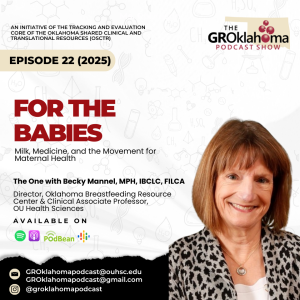
In this episode, we sit down with Becky Mannel, a trailblazer in maternal and infant health whose journey began with a personal frustration: being a new mom struggling to breastfeed with no one around to help, not even in a hospital full of physicians. That experience lit a fire that would lead her to become a nationally recognized lactation advocate, Executive Director of the Oklahoma Mothers’ Milk Bank, and a leader in reshaping infant health policy in the state.
Becky shares how she entered the field after years of raising her children at home, and how she gradually carved out a professional path in a space that was still under-recognized and under-resourced. From launching Oklahoma’s first and only human milk bank to spearheading legislation protecting breastfeeding rights, her work sits at the intersection of public health, equity, and systems change.
One of the most powerful moments of the conversation centers around a case study involving a foster infant with failure to thrive. When formula failed and Medicaid wouldn’t cover donor milk, Becky’s advocacy — and a dramatic clinical turnaround — ultimately helped change policy in the state. She discusses how stories like these illustrate why lactation care is not just a personal matter, but a critical public health issue with long-term consequences.
Throughout the episode, Becky reflects on the importance of interdisciplinary collaboration, listening to stakeholders, advocating with data, and staying rooted in purpose. From beginning-of-life care to the quiet parallels she shares with her husband’s work in cancer and end-of-life care, this conversation serves as a reminder that our systems only function effectively when we center on people and their lived experiences.
If you care about public health, health equity, maternal care, or policy translation or if you just love a good story about someone who turned a personal pain point into statewide impact — this one’s for you.
The GROklahoma Podcast is an initiative of the Oklahoma Shared Clinical and Translational Resources (OSCTR).
Friday May 23, 2025
Friday May 23, 2025
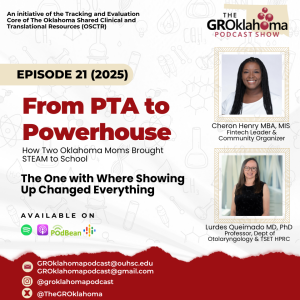
What happens when a powerhouse in fintech and a molecular biologist walk into a PTA meeting? Magic, in the form of STEM nights, community grants, and generational impact.
In this heartwarming episode, Dr. Lurdes Queimado (MD, PhD), a physician-scientist whose journey began in a rural Portuguese village under dictatorship rule, and Cheron Henry (MBA, MIS), a fintech leader and equity advocate born and raised in Oklahoma, share how their unlikely partnership sparked a transformation at Red Oak Elementary in Oklahoma City. What started as a casual conversation at a school PTA meeting turned into a powerful collaboration rooted in shared values, volunteerism, and an unwavering belief in the power of education.
Together, they brought STEAM—Science, Technology, Engineering, Arts, and Math—out of textbooks and into Oklahoma students' hands through interactive experiences like banana suturing and bridge-building. Their story is a testament to how grassroots action, even amid personal and professional challenges, can lead to meaningful change. Lurdes shares how she balanced academic life while caring for a loved one undergoing cancer treatment. Cheron reflects on impostor syndrome and the strength it takes to lead as a Black woman in Oklahoma’s tech industry, all while raising her family and staying present in her community.
This episode isn’t just about STEM. It’s about showing up, doing what you can with what you have, and believing that your presence matters, especially in schools across Oklahoma. Whether you're a researcher, parent, mentor, or someone wondering if the PTA is worth your time, this conversation will move you. It’s a call to action for anyone who has ever doubted the ripple effect of small efforts or wondered whether they had enough time to give. (Spoiler: you do. And the impact is bigger than you think.)
Wednesday Apr 30, 2025
Wednesday Apr 30, 2025
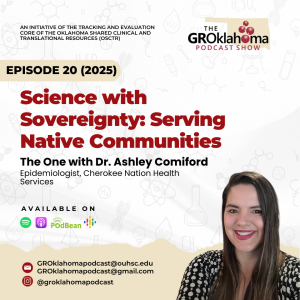
Continuing our exploration into Native American and American Indian health, this episode features Dr. Ashley Comiford, an epidemiologist at Cherokee Nation Health Services and a fierce advocate for equity. From a small Oklahoma town to leading research on cancer disparities, infectious disease, and tobacco-related illness, Dr. Comiford shares the powerful story of how her Cherokee identity shaped her path in public health.
She pulls back the curtain on what it truly means for American Indian/Alaska Native tribes to be sovereign nations and how this legal and cultural reality influences everything from healthcare access to who owns the data in research. We also discuss the challenges of conducting ethical, community-led research, the importance of tribal Institutional Review Boards (IRBs), and what sustainable partnerships should entail. She also reflects on her frontline work during the COVID-19 pandemic and explains why the recent $17 million NIH ICON grant could be a game-changer for cancer outcomes in Native communities.
This episode is as personal as it is a political reminder that data without trust is dangerous, and that the most impactful science is built in collaboration with, not on, the comPlease tunety. Tune in to hear from a public health leader who’s turning her lived experience into systemic change and lighting the way forward for Native health equity.
Subscribe to the GROklahoma Podcast for conversations that bridge research, equity, and community—from Oklahoma and beyond. New episodes drop monthly. Stay curious. Stay connected.
Monday Mar 24, 2025
Monday Mar 24, 2025
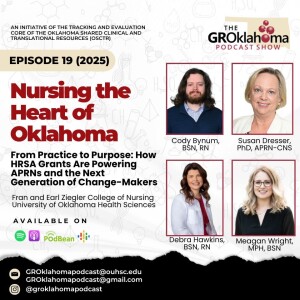
In this powerful episode, we explore how a federally funded initiative is shaping the future of healthcare across rural Oklahoma. Joining us are Dr. Susan Dresser, Regents Professor and Adult-Gerontology Clinical Nurse Specialist at the Fran and Earl Ziegler College of Nursing, OUHS, and three exceptional DNP students: Cody Bynum, Meagan Wright, and Debra Hawkins—each a recipient of the Oklahoma Workforce Innovations in Nursing grant, funded by the Health Resources and Services Administration (HRSA).
The grant, awarded in 2023, is a $2.5 million initiative designed to increase access to quality healthcare by preparing Advanced Practice Registered Nurses (APRNs) to serve rural, tribal, and medically underserved communities. The grant supports tuition, clinical placements, interprofessional education, and training rooted in cultural humility and healthcare access.
Together, our guests share:
Their deeply personal journeys into nursing—from military service and rural ICU caregiving to a lifelong dream reignited after raising families.
The barriers to healthcare in Oklahoma, including provider shortages, chronic disease, and poverty.
How Clinical Nurse Specialists (CNSs) bring evidence-based practice to the bedside and improve care at the systems level.
The impact of immersive clinical training experiences in correctional health, homeless shelters, and Native communities.
Why telehealth, policy change, and interprofessional collaboration are essential for expanding care in hard-to-reach places.
This conversation offers an honest, inspiring look into how Oklahoma nurses are meeting patients where they are—and how the HRSA grant is helping build a workforce ready to lead, serve, and innovate across the state.
Friday Feb 28, 2025
Friday Feb 28, 2025
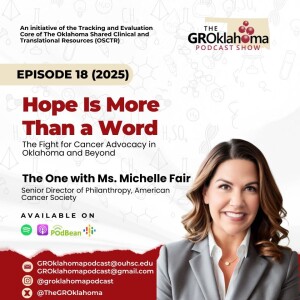
Hope isn’t just a word—it’s action. It’s advocacy. It’s ensuring that no one has to choose between paying for cancer treatment and keeping a roof over their head. In this inspiring episode, we sit down with Michelle Fair, a dynamic leader in corporate philanthropy at the American Cancer Society (ACS), who has spent her career turning hope into tangible support for cancer patients.
As Senior Director of Corporate Relations and Philanthropy, Michelle manages major donor and corporate partnerships across Oklahoma, Arkansas, Mississippi, and Arizona. Her journey is anything but conventional—starting in molecular biology, she pivoted to international finance and nonprofit leadership, raising over $25 million for cancer programs, including leading the $16.5 million capital campaign that brought the ACS Chad Richison Hope Lodge to life in Oklahoma City.
In this episode, Michelle opens up about the challenges and triumphs of fundraising for major cancer support initiatives, how she builds strong donor relationships, and what it takes to lead high-impact projects in a constantly evolving nonprofit landscape. She also shares how her grandmother’s legacy of generosity shaped her career and how she balances the demands of leadership, family, and personal growth.
Whether you’re in the nonprofit world, considering a career shift, or just looking for an inspiring story about resilience and impact, this conversation is packed with wisdom, heart, and so many gems. Outside of her work, Michelle is an avid reader, traveler, and advocate for women in leadership, passionate about mentoring the next generation of fundraisers and changemakers. Boldness and persistence can truly transform lives—and Michelle’s story proves it.
Sunday Jan 12, 2025
Sunday Jan 12, 2025
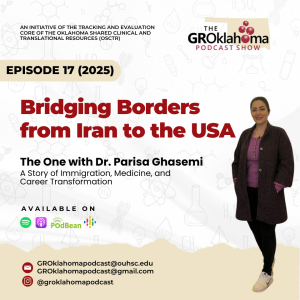
The US, especially Oklahoma, is home to immigrants who play a vital role in shaping the healthcare landscape. Dr. Parisa Ghasemi is one such immigrant, making significant contributions to healthcare research. In this first episode of The GROklahoma Podcast for the year, we speak with Dr. Ghasemi, a physician, researcher, and lab administrator for The MORE Lab at the Health Promotion and Research Center (HPRC), where she focuses on cancer and lupus outcomes.
Dr. Ghasemi shares her personal and professional journey—from her upbringing in Iran and the support of her family in pursuing medicine, to adapting to a new culture and navigating the challenges of starting over in the US. She discusses her transition from clinical practice to research, the struggles of being an immigrant professional, and the importance of adaptability and resilience.
As a physician, Dr. Ghasemi reflects on the emotional challenge of shifting from patient care to research, noting that “the satisfaction that you feel right after helping a patient in clinical work isn't present in research.” Yet, her passion for making a broader impact through research continues to drive her forward.
In this special episode, we also reflect on the GROklahoma Podcast itself, exploring how it has fostered connections, amplified voices, and highlighted the incredible work being done in Oklahoma’s healthcare and research sectors. Dr. Ghasemi offers her feedback on the podcast and shares valuable advice for those considering similar career transitions.
Tune in to hear how Dr. Ghasemi’s inspiring journey can resonate with anyone facing similar challenges. This episode marks a fitting start to our podcast for the year, celebrating the resilience, growth, and hope that define the immigrant experience in healthcare. Wishing you all a Happy New Year and a year filled with growth and collaboration!

The GROklahoma Podcast Show
Join us on The GROklahoma Podcast Show as we explore the world of clinical and translational research in Oklahoma. Discover resources, funding opportunities, collaboration platforms, and more to support your research journey. Whether you're a seasoned researcher or just starting out, our podcast connects you with the tools and expertise to propel your work forward. Subscribe and join our community of researchers pushing boundaries and making a difference in Oklahoma's research landscape.